
Solana has really made a name for itself in the blockchain world, especially when you look at how fast it can handle transactions and how little it costs. This article will break down how Solana manages to be so quick and affordable, looking at things like its transaction speed and fee structure. We'll also dig into how stablecoins are growing on Solana, which is a big deal for its future. It's all about understanding what makes Solana tick and why it matters for digital money.
Key Takeaways
- Solana processes transactions very quickly and at a low cost, making it stand out among other blockchains.
- The network's speed comes from its unique design, allowing it to handle many transactions at once.
- Fees on Solana are quite low, usually just a fraction of a cent, which helps keep things affordable for users.
- Stablecoin Growth on Solana is a big deal, with more and more stablecoins being minted and used on the network.
- The growth of stablecoins on Solana points to its potential for everyday payment uses, thanks to its efficiency.
Understanding Solana's Transactional Efficiency
Solana's High Throughput Capabilities
Solana is known for its impressive speed. It's built to handle a lot of transactions quickly.
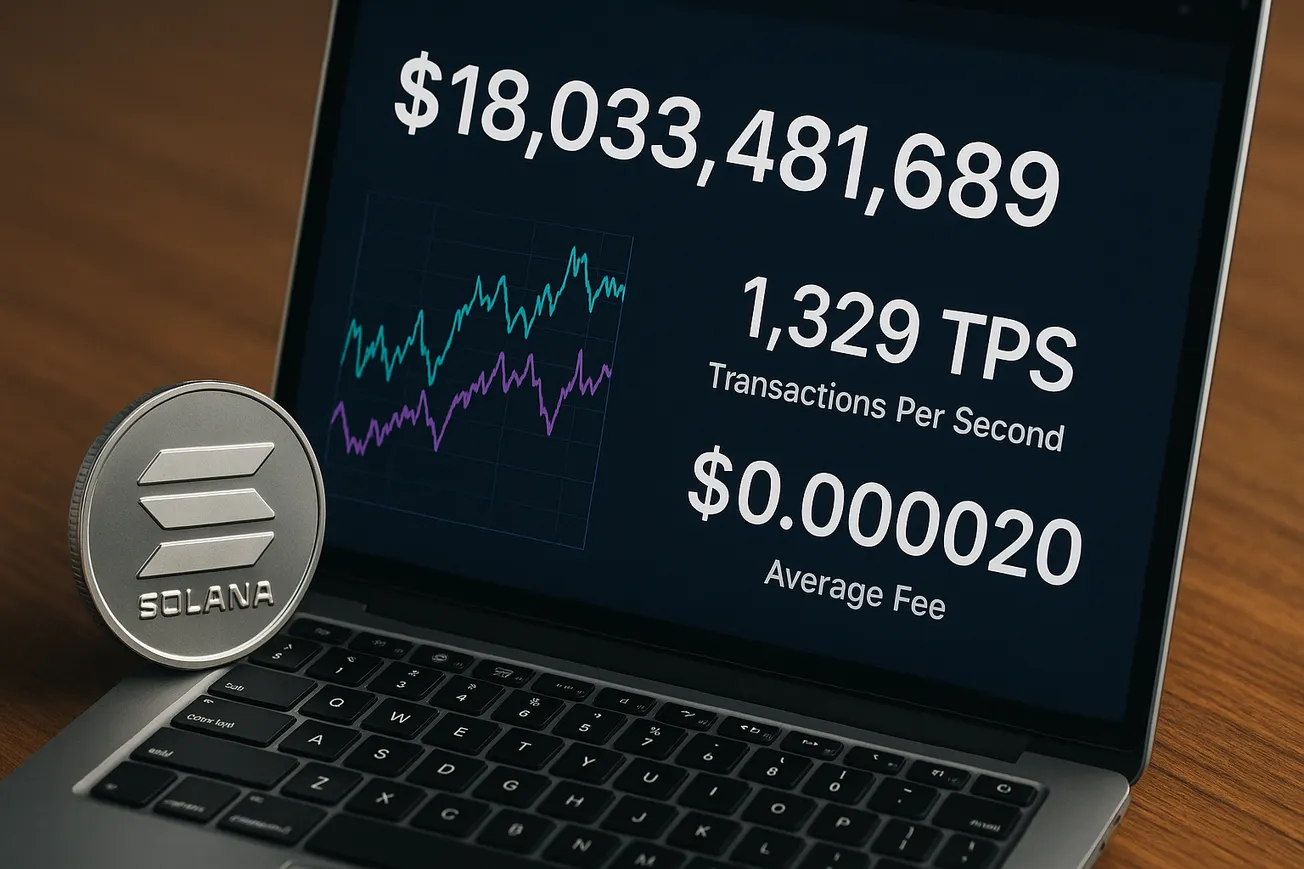
Solana's architecture allows it to process thousands of transactions per second (TPS). This makes it stand out compared to other blockchains.
Think of it like this: Solana is like a super-fast highway for transactions, while other blockchains are like slower, smaller roads. This difference in speed is a big deal for many applications.
Factors Contributing to Solana's Speed
Solana achieves its speed through a few key innovations. One is Proof of History (PoH), which helps to order transactions efficiently.
Another is its parallel processing capabilities. This means it can handle multiple transactions at the same time.
Validator node performance also plays a big role. Nodes with better hardware and faster internet connections help the network run smoothly. Regular software updates are also essential to maintain and improve the network’s scalability.
Real-World Applications of Solana's Speed
Solana's speed has a real impact on how people use it. For example, in decentralized finance (DeFi), fast transactions mean smoother trading and lending.
NFT marketplaces also benefit, allowing users to mint and transfer NFTs almost instantly. Gaming and other decentralized applications (dApps) also see improved user experiences because of the speed. bridging stablecoins is easier with faster transaction times.
Solana's high throughput and low fees make it attractive for applications that require fast and cheap transactions. This includes things like micro-payments, high-frequency trading, and other use cases that would be impractical on slower, more expensive blockchains.
Analyzing Solana's Fee Structure
Affordable and Predictable Transaction Costs
Solana's fee structure is one of its biggest selling points, especially when you compare it to other blockchains. The goal is to keep fees low and predictable, which is super important for any application, especially stablecoins. Think about it: if fees are all over the place, it's hard for businesses and users to plan.
Solana achieves this through its architecture, which allows for high throughput and efficient block validation. This prevents the network from getting congested, which is what usually causes fees to spike on other chains like Ethereum.
Mechanisms Behind Low Solana Fees
So, how does Solana actually keep fees so low? A few things are at play here. First, Solana uses a parallelization approach, which means it can process many transactions at the same time instead of one after the other. This is a big deal because it significantly increases throughput.
Second, Solana has something called local fee markets. These markets partition database hot spots, which helps to avoid congestion in specific areas of the network. Jito's transaction segmentation engine also plays a role by making transactions more affordable and predictable.
Finally, Solana's hardware requirements are also a factor. It uses a proof-of-stake consensus mechanism, which is less energy-intensive than proof-of-work. Plus, it leverages GPU computing power, which helps to speed up transaction processing.
Fee Distribution and Validator Incentives
So, who gets the fees, and how does it all work? Well, the user who initiates the transaction typically pays the fee. These fees are then distributed to validators as a reward for processing transactions and securing the network.
Validators are incentivized to prioritize transactions based on a fee-to-compute-unit ratio. This means that smaller, less intensive transactions can land for much lower fees than big, heavy transactions. It's all about efficiency.
Solana's fee structure is designed to be both affordable and sustainable. By distributing fees to validators, the network ensures that there is always an incentive to process transactions and maintain the network's security. This creates a positive feedback loop that helps to keep fees low and throughput high.
Key Performance Metrics for Solana

Raw Transactions Per Second Explained
Okay, let's talk about TPS. It's easy to get caught up in the numbers, but what does it really mean? Raw TPS is basically the theoretical maximum number of transactions the network can process per second.
It's a good headline, but it doesn't always reflect real-world performance. Think of it like the speedometer in your car – it shows how fast you could go, not necessarily how fast you are going. Solana's performance and TPS are impressive, but it's important to look at sustained rates, not just peak numbers.
Block Time and Its Impact
Block time is the average time it takes for a new block to be produced on the blockchain. Solana aims for a block time of around 400 milliseconds. This fast block time is one of the reasons why Solana can achieve high throughput.
However, shorter block times can sometimes lead to increased network congestion if not managed properly. It's a balancing act. A faster block time means quicker confirmations, but it also puts more strain on the network.
Transactions Per Block Analysis
Transactions per block (TPB) tells you how many transactions are packed into each block. Analyzing TPB helps understand network utilization. If blocks are consistently full, it indicates high demand and potential congestion.
If blocks are mostly empty, it suggests the network has plenty of capacity. Monitoring TPB over time can reveal trends and help predict future network behavior. For example, during a popular NFT mint, you'd expect to see a significant increase in TPB.
It's important to remember that these metrics don't exist in a vacuum. They need to be considered together to get a complete picture of Solana's performance. Looking at TPS without considering block time or TPB is like only looking at one piece of a puzzle. You need all the pieces to see the whole picture.
Here's a simple table to illustrate:
| Metric | Description | Importance |
|---|---|---|
| Raw TPS | Theoretical maximum transactions per second | Headline metric, but not always representative of real-world performance |
| Block Time | Average time to produce a new block | Impacts confirmation speed and network strain |
| Transactions Per Block | Number of transactions included in each block | Indicates network utilization and potential congestion |
To summarize, understanding these key performance metrics is crucial for assessing Solana's efficiency and scalability.
Compute Unit Performance on Solana
Beyond Transactions Per Second: The Role of Compute Units
TPS is cool and all, but it doesn't tell the whole story. It's like judging a car solely on its speedometer without looking at the engine's horsepower.
Compute Units (CUs) give us a much better idea of how hard the network is actually working. Think of CUs as the 'effort' required to process a transaction. A simple transfer will use fewer CUs than, say, interacting with a complex DeFi protocol.
For example, a basic SOL transfer might consume a relatively small number of CUs, while a complicated swap on a decentralized exchange could require significantly more. This is because the swap involves multiple steps, including smart contract execution, token validation, and state updates.
Successful Versus Failed Compute Units
It's not just about how many CUs are used, but also whether those CUs resulted in a successful transaction. Looking at the ratio of successful to failed CUs can tell us a lot about network health and the types of issues users are running into.
If we see a spike in failed CUs, it could indicate problems with specific smart contracts, network congestion, or even malicious attacks. Monitoring this metric helps developers and network operators quickly identify and address potential problems.
For instance, if a new DeFi protocol is launched and immediately starts generating a high number of failed transactions (and thus, failed CUs), it might point to bugs in the smart contract code that need immediate attention. This is why understanding stablecoin velocity 2025 is important.
Understanding Compute Unit Utilization
Solana has a maximum number of CUs available per block. Currently, it's around 50 million, with plans to increase it.
Tracking how much of this capacity is actually being used gives us a sense of how close the network is to its limits. High utilization rates can signal a need for further optimization or scaling solutions.
Monitoring compute unit utilization is like checking the temperature gauge on your car's engine. If it's consistently running near the redline, you know you need to take action to prevent overheating. Similarly, consistently high CU utilization on Solana suggests the network is approaching its capacity limits and may benefit from upgrades or optimizations.
Here's a simplified example of how CU utilization might look over time:
| Time | Total CUs Available | CUs Used | Utilization Rate |
|---|---|---|---|
| 10:00 | 50,000,000 | 25,000,000 | 50% |
| 10:15 | 50,000,000 | 40,000,000 | 80% |
| 10:30 | 50,000,000 | 48,000,000 | 96% |
As you can see, the utilization rate increased significantly over just 30 minutes, indicating a surge in network activity. This kind of data is super useful for making informed decisions about network upgrades and resource allocation.
Here are some things to keep in mind when looking at CU utilization:
- Context is key: A high utilization rate isn't always bad. It could simply mean the network is being used efficiently.
- Look for trends: Sudden spikes or sustained high utilization are more concerning than occasional peaks.
- Consider the types of transactions: Some applications naturally consume more CUs than others.
Stablecoin Growth on Solana: A Deep Dive
Current Stablecoin Total Value Locked
Solana has become a significant player in the stablecoin arena. It's interesting to see how much value is locked in stablecoins on Solana right now.
As of January 2025, Solana's stablecoin TVL hit an all-time high of $10.7 billion. This shows a strong and growing interest in using Solana for stablecoin-related activities.
Recent Stablecoin Minting Trends
Looking at how many stablecoins are being created can tell us a lot about the network's health. It also shows how people are using stablecoins on Solana.
From January 15-21, 2025, over $3 billion in stablecoins were minted on Solana. This indicates a very active period for stablecoin usage and adoption.
Implications for Stablecoin Payment Use Cases
All this growth has big implications for how stablecoins can be used on Solana. It opens up new possibilities for payments and other applications.
With such a large amount of stablecoins available, Solana is well-positioned for various payment solutions. These include cross-border payments, point-of-sale systems, debit cards, and yield generation strategies.
The increasing stablecoin activity on Solana suggests a bright future for onchain payments. The network's speed and low fees make it an attractive option for developers and users alike. This could lead to even more innovative applications and greater adoption of stablecoins in everyday transactions.
Here are some potential use cases:
- Cross-border payments: Stablecoins can make international transactions faster and cheaper.
- Point of sale systems: Businesses can accept stablecoins for everyday purchases.
- Decentralized finance (DeFi): Users can earn yield on their stablecoins through lending and borrowing platforms.
Impact of Local Fee Markets on Solana
How Local Fee Markets Enhance Predictability
Solana's local fee markets are a game changer. They bring a level of predictability to transaction costs that's pretty rare in the blockchain world. Instead of one big global fee market, Solana breaks things down into smaller, more manageable chunks. This means that if one part of the network is congested, it doesn't necessarily impact the fees for transactions happening elsewhere.
This is especially important for stablecoin payments, where consistent and low fees are a must. Imagine trying to buy a coffee with stablecoins and the transaction fee suddenly spikes because some DeFi protocol is having a crazy day. Not ideal, right? Local fee markets help avoid that.
Transaction Segmentation Engine's Role
Jito's transaction segmentation engine is a key piece of this puzzle. It's designed to further refine how transactions are processed, making sure that even during peak network activity, stablecoin transactions can still get through at reasonable costs.
Think of it like a smart traffic controller for the blockchain. It prioritizes certain types of transactions, ensuring that critical applications like stablecoin payments aren't held up by less important stuff. This is a big deal for businesses that want to use stablecoins for everyday transactions. They need to know that the fees won't suddenly jump and make the whole thing uneconomical.
Parallelization for Enhanced Throughput
Solana's native parallelization is another factor that helps keep fees low and predictable. Unlike some blockchains that process transactions one at a time, Solana can handle multiple transactions simultaneously. This dramatically increases throughput and reduces congestion, which in turn keeps fees down.
This parallel processing is a major reason why Solana can handle so many transactions per second (TPS) compared to other blockchains. It's like having multiple checkout lanes open at a grocery store instead of just one. More lanes mean faster service and less waiting, which translates to lower fees and a better user experience.
Solana's approach to fees is all about making the network more usable for everyday applications. By breaking down the fee market and processing transactions in parallel, Solana is creating a more stable and predictable environment for stablecoin payments and other use cases. This is a big step forward in making blockchain technology more accessible and practical for the average person.
Solana's Revenue and Valuation Metrics
Monthly Aggregate Revenue and Fees
Solana has been making waves with its revenue figures. In January 2025, it actually topped the charts in monthly aggregate revenue and fees, even though its per-transaction fees are lower than some other blockchains. This shows just how much activity is happening on the Solana network.
That's a pretty big deal, and it suggests that Solana is becoming a go-to platform for various applications.
Components Driving SOL Token Value
Several things influence the value of the SOL token. Its utility within the Solana ecosystem is a big one. Staking yields also play a role, as does Maximum Extractable Value (MEV), all of which are tied to how busy the blockchain is.
More on-chain activity generally means a higher SOL token value.
Comparative Valuation Against Other Blockchains
When you stack Solana up against other blockchains, things get interesting. Even though Solana often shows better performance, growth, and activity metrics, its market capitalization is still only about a quarter of Ethereum's.
It also trades at lower valuation multiples compared to its peers. This could mean that Solana is currently undervalued, especially when you consider its potential and the amount of development happening on the platform.
Solana's ability to generate significant revenue with lower fees points to a highly efficient and active ecosystem. This efficiency, combined with strong growth in total value locked (TVL) and on-chain activity, positions Solana as a strong contender in the blockchain space.
Future Enhancements and Network Scalability

Firedancer's Potential Impact on TPS
Firedancer, a new validator client, is poised to significantly boost Solana's transaction processing capabilities. It's expected to push the network to around 1 million TPS in a test environment. This upgrade aims to improve network security and reliability, reducing downtime risks.
It's a big deal because it could solidify Solana's position as a top-performing blockchain. Validator Performance is key to this.
Base's Scaling Approach Compared to Solana
Base, operating on a single-threaded EVM, scales through software optimizations and hardware upgrades. They're committed to increasing Base’s block capacity, but their approach differs from Solana's parallel processing.
Base processes sequencer transactions off-chain in batches before finalizing them on Ethereum. This decouples user fees from Ethereum congestion. It's a different strategy compared to Solana's on-chain enhancements. Tether's journey is interesting to compare.
Continuous Improvements for Block Capacity
Solana is constantly being upgraded and improved through community proposals. Anyone can submit a Solana Improvement Document (SIMD) to suggest changes. If a proposal gains enough support, the community votes on whether to implement it.
These SIMD proposals are crucial for Solana's adaptability in the ever-changing market. They ensure the network remains a dominant blockchain platform.
Here are some areas of ongoing improvement:
- Validator Performance & Optimization
- Layer 2 & Scaling
- Decentralized Storage & IPFS
The network is regularly being upgraded and improved. This ensures Solana remains competitive and efficient. Local fee markets are also important.
Conclusion
So, what's the big takeaway here? Solana is really making a name for itself when it comes to stablecoins. The numbers, like its transaction speed and super low fees, show it's a serious player. It's not just about how many transactions it can handle, but also how cheap and quick those transactions are. This makes it a good spot for stablecoins, which need to move fast and not cost a lot. As more people and businesses start using stablecoins, Solana's tech looks like it's ready to handle that growth. It's pretty clear that Solana is set up to be a big part of the stablecoin world going forward.
Frequently Asked Questions
How does Solana process transactions so fast?
Solana can handle a lot of transactions very quickly because it uses a special way of ordering them, called Proof of History, along with a fast way to agree on new blocks, called Proof of Stake. Think of it like having a super-efficient assembly line that can process many items at once.
How much does it cost to make a transaction on Solana?
A typical transaction on Solana costs about $0.00025, which is a tiny fraction of a penny. This is much cheaper than many other blockchain networks.
Why are Solana's transaction fees so low?
Solana's fees are low because its system is very good at handling many transactions at the same time without getting clogged up. When a network gets busy, fees usually go up, but Solana avoids this by being so efficient.
Who pays the transaction fees on Solana?
The person who starts the transaction usually pays the fee. These fees then go to the 'validators' who help keep the network running smoothly and securely.
How quickly do transactions happen on Solana?
Solana is incredibly fast, with an average block being added every 400 milliseconds. This means it can handle up to 65,000 transactions every second when things are running perfectly. This speed makes it one of the quickest blockchains around.
What are the benefits of Solana's fast transaction speeds?
Solana's high speed is great for many things, like fast trading on money apps, quick buying and selling of digital collectibles (NFTs), and smooth experiences in blockchain games and other apps.